top of page

You don’t have to save me, you

just have to hold my hand

while I save myself.
Unknown

Blog Posts

As a freelance writer of creative nonfiction, I write to inspire hope for those struggling to heal from trauma. Thanks for reading my posts. If you'd like to read my archived blog posts, use this link.

Bottom line: In spite of COVID risks, we took measures to protect ourselves and enjoyed our trip.


During our “Christmas on the Miss” cruise, Janet and I traveled on the American Duchess down the Mississippi River from Memphis, TN to New Orleans, LA, known by locals as NOLA.


1) The Duchess is a stern-wheeler, with two wheels side by side located at the stern, as opposed to one paddle wheel on each side of the boat, aka a side-wheeler.

ree

Janet poses with the American Duchess docked in Greenville, MS.


2) Headwaters of the Mississippi River flow from a spring that feeds Lake Itasca, Minnesota, elevation 1,475 feet. With a length of 2,341 miles, the Mississippi drops 7.560871422 inches per mile until it merges with the Gulf of Mexico beyond New Orleans.


3) The “Duck March” at the Peabody Hotel in Memphis is quite popular among people . . . as well as the ducks.


Peabody Hotel Duck March in Memphis,TN.


4) The Blues City Cafe in Memphis doesn’t believe in customers going away hungry. When I inquired about possible menu misprints, the waitress said, “We don’t have (ounce) steaks.” I thought better of ordering their largest sirloin. Then, the waitress mentioned something about a family meal. Indeed!

ree

Really? Never mind the shrimp, fish, and chicken.


ree

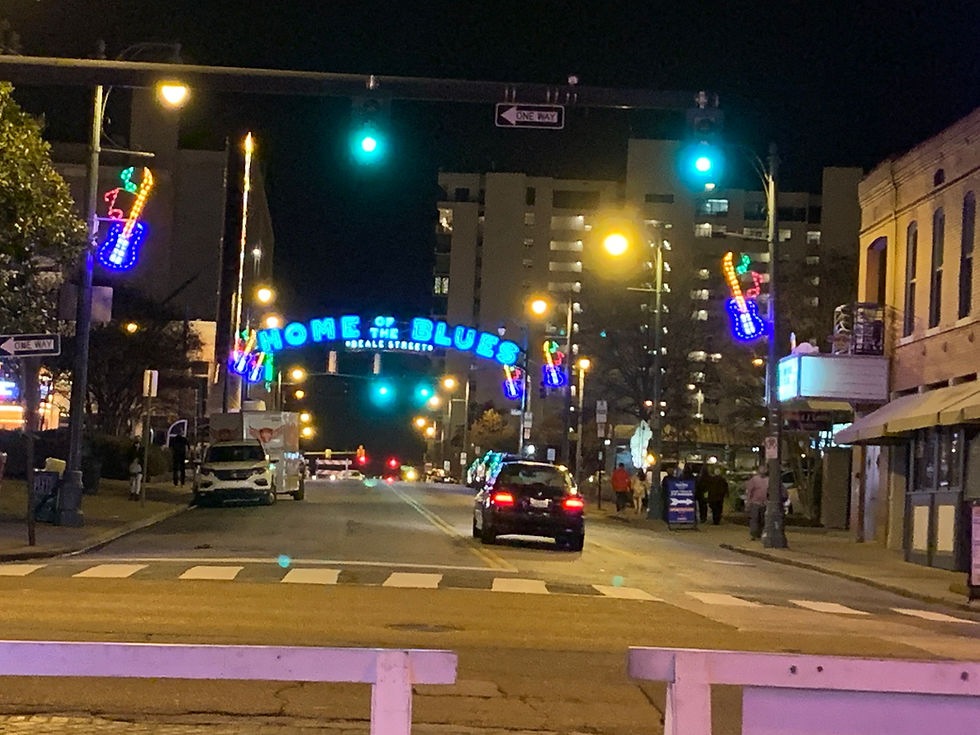
Beale and Main Streets near the Blues City Cafe in Memphis.

5) Janet and I "toured" the World's First Billy Bass Adoption Center at the Flying Fish Restaurant in Memphis.

ree

The main Billy Bass display wall in the Flying Fish Restaurant.


ree

Wouldn't cha' know? Another Elvis Impersonator!


6) Janet had to visit Elvis' Graceland. She just had to, no ifs, ands, or buts.


ree

Elvis' Graceland home is much like many pre-Civil War

plantation homes across the deep south, after a fashion.


7) Elvis' taste in home decorating, 1970s era, was nothing to envy.


ree

Elvis' 1970s Media Room (pre-internet social media).


8) Elvis owned and traveled via two planes.


ree

The Lisa Marie, largest of Elvis' two jets.


9) Elvis owned horses, and purchased numerous cars and motorcycles during his short career. I can't comment about the color of his horses, as I saw none, but his choice of Cadillac color suggests he believed if you got it, flaunt it.


ree

Elvis' Pink Cadillac.


10) The Delta, aka Yazoo-Mississippi Delta, of some 70,000 sq miles of alluvial floodplain in Arkansas, Louisiana, and primarily Mississippi, should not be confused with the Mississippi River Delta, which terminates some miles beyond New Orleans.

11) The Delta suffered major flooding in 1927, the most destructive in US history, when the levee first failed near Mounds Landing, some 17 miles from Greenville, Mississippi. Some areas were covered by as much as thirty feet of water and at least two months elapsed before the floodwater completely subsided.


ree

The Mississippi Delta, not to be confused with

the Mississippi River Delta southeast of NOLA.


12) Greenville, Mississippi, boasts of “more published writers per capita” than any other town in the US, such notables include Shelby Foote.


Their published author's list as displayed at the

Greenville Writers Exhibit at the Percy Library.


13) Many consider The Delta as the birthplace of Blues music, and highly influential in the development of Rock and Roll, if not its birthplace as well.


14) The Mississippi River temporarily ran backwards after a series of New Madrid fault earthquakes between December 16, 1811 and February 7, 1812. Additionally, those tremors created 18-mile-long Reelfoot Lake in TN.


ree

Reelfoot Lake near Tiptonville, TN. Note: Photo taken during a separate trip.


15) The NMSZ, New Madrid Seismic Zone, is not benign nor dormant. Ruptures have occurred numerous times and have been felt and recorded in personal journals as far away as Louisville, Kentucky and Cincinnati, Ohio.


16) Though many consider cotton the primary crop of the pre-Civil War South, corn and sugarcane figured prominently. Corn fed farm animals and sugarcane helped fuel the opulent plantation culture built upon slave labor. Touring a few notable houses on our trip, I was reminded of European royal palaces.


ree

Nottoway Plantation Mansion. Note: Gentlemen, please

ascend on the right as to not glimpse bare feminine ankle.

17) Gators love marshmallows. Wait . . . why are they called “marsh” mallows?


ree

Several swamp gators compete for a marshmallow. Note: the brown &

green is vegetation reflecting off the water, not muck in the water.


18) Cafe Du Monde’s beignets, French doughnuts, aka fritters, are popular in the French Quarter of NOLA. Janet and I opted to stand in the take-away line for almost an hour to purchase an order, as the sit-down line appeared longer. I’m sure both lines had formed hours before our arrival, with customers placing and consuming their orders all the while. And when Janet and I left, the lines had grown longer still.


ree

Queue for Cafe Du Monde beignets when Janet and I arrived on the scene.


19) Janet and I found the World War Two Museum in NOLA interesting, as we spent nearly a whole day there. I liked the museum's display of US WWII planes.


ree

Surely, that Avenger wasn't dropping a live bomb.

Probably not. Well, maybe not. I hoped not, anyway.


20) I'd expect to be hanged and quartered, if I didn’t mention Southern and Cajun cuisine, other than that above. Both Janet and I enjoy Cajun food, though only lightly spiced. However, Janet shies away from deep-fried breaded items, particularly catfish. Her catfish aversion has something to do with owning a pet catfish years ago, but that didn't deter me, at least on one occasion.


ree

Prepared to chow down on fried alligator, crab cake and raw oysters, Connard photo

bombs Janet's foodie picture at the Coterie Restaurant & Oyster Bar, NOLA.

Note: Gator tastes like a cross between chicken and ground beef to me.


  • Writer: Connard Hogan
    Connard Hogan
  • Dec 2, 2021
  • 6 min read

Updated: Aug 26, 2022

Bottom line: Blisters are a tenderfoot hiker’s reward.


ree

Prim8's new Hoka hiking boots. Blister preventers?


11.10.21

Mr. New Boots, that is Prim8 equipped with new hiking boots, and I had arrived at our rendezvous point at the terminus of state road 173 in advance of "Wrong-way" Mark. There, we discovered 173, now blocked off, had been a through road leading from the relative flat terrain nearer Hesperia into the mountains to Lake Arrowhead.

Wide open terrain. We’ve made progress, Prim8.

Out of the mountains? Prim8 replied.

Not entirely.

I’d grown tired of the elevation gains and losses over the miles we’d hiked around Big Bear, but I knew full well, implied by the name, the Pacific Crest Trail had many more hills and mountains to ascend and descend before our journey’s goal will be reached.

Since our last jaunt, Prim8 and I purchased a pair of Hoka Stinson One hiking boots in hopes of warding off pesky foot blisters, the bane of many hikers. Prim8 had had enough of dealing with blisters and I wasn’t too happy about them, either. We hoped we’d solved the blister conundrum and our feet would hike in bliss, having achieved footwear nirvana.

"Add another mile or so to our hiking distance tomorrow," Mark said.

What? "Another mile?"I pictured our 24.5-mile hike down hill towards the Whitewater Preserve some months ago.

We left my car at road end, turned parking lot, in anticipation of our arrival on foot the next day. Then, Mark drove us into Big Bear where Prim8 and I stuffed ourselves with Mexican barbacoa, aka slow cooked meat, washed down with beer, before retiring to our motel room.


11.11.21 Crab Flats to PCT/173 Junction

Up at 4:45AM, we brewed coffee in our rooms, snacked on dried fruit, and consumed bacon prepared by Mark, both pork and turkey, before we set off for our trailhead destination at Crab Flats.


The chilled air and starry sky portended a good weather day.

I sucked down additional coffee as best I could as we bounced around over the rutted gravel/dirt road, generally unfit for most vehicles and designed OHV, aka off-highway vehicle. In the meantime, both Mark and I drank water from disposable plastic bottles, in order to maximize our levels of hydration. I discovered long ago that water is not weightless, so I’ve developed the practice of drinking my fill before the day’s hike, though I carry a prudent supply, as well. Nothing good comes from dehydration.

Last minute gear checks completed and packs donned, we walked away from Mark’s vehicle.

"What time is it?" I asked.

"7AM," Mark replied.

A tad later than we’d hoped.

"And what’s the temperature?"

"I’ve got 43 degrees," Mark said.

"Good temperature," I said. "It’s easier to get warmer, than cooler." I knew we’d warm up within a few minutes from hiking exertion.

All the while, I consoled Prim8 with the delusion that we’d lose elevation, 2301 feet, over the course of our day’s hike. But, you have to know, that the PCT meanders up, around and down mountainsides! So, the accumulated elevation gain would be 240 feet and the elevation loss would be 2414 feet, which amounts to a 2654-foot differential. Doesn’t sound like much, but everything adds up.

And the trail led us up, around and down.

Rest a minute.

After a brief pause, I continued onward.

Grab a snack.

My leg muscles and feet aching with fatigue, I'd found another excuse to rest a minute.

I hiked some more. The trail wound along, overlooking Deep Creek drainage.

Nice view of fall colors. Pause for a scenic photo.


ree

Though the area remains in drought, fall colors show in Deep Creek Canyon.

The ache of my leg muscles had deepened.

What’s with this?

With clear sky above, temperatures climbed into the low-mid 70s. An occasional light breeze lifted my spirit.

And we’ve got shade now and then.

The trail continued up, down, and around. Up, down, and around.

How are you doing, feet?

Aside from the ache and fatigue, I detected no blisters.


ree

"Wrong-way" Mark pauses for a rest on the opposite side of

the rainbow painted arch bridge which crosses Deep Creek.

When I caught up with Mark, who's been leading the way, on the opposite side of the arch bridge which crosses Deep Creek, he said, “You’re eight minutes behind me. Not bad.”


"Could’ve fooled me," I said. "We must be getting close." I meant to my car.

"Another 4 miles from here," Mark said.

Ugh, Prim8 said.

Slog it out, fella.

Having crossed Deep Creek and with the trail direction shifted westward, we came into full sun. The sun, on its late afternoon downward leg and lower in the sky, however, didn’t scorch us.

Though seemingly forever to come into sight, the trail winding this way, then that, we approached the Mojave River Dam.

Nearly there. Then, another mile to go.

My legs and feet continued their ache.

What’s the damage done this time?

We followed a gravel road about half a mile on gentle rising terrain to the tunnel where Deep Creek flows. Here, we faced foot-deep water about twenty-feet across. After removing my boots and socks in preparing to fjord the Deep Creek, my iPhone took a bath.

Plop! A short, tiny little dink. What could that be?

I spotted my iPhone resting in a few inches of water. "Crap, I dropped my phone in the water," I said, as I retrieved it. I gave it a good shaking and hoped for the best.

"You probably shouldn’t carry it on your belt," Mark said.

"Yeah, I know," I said. "I wanted it handy to take photos, but I guess the belt holder wasn’t designed for hiking." Should’ve learned that lesson when your phone fell off earlier in the day, twice.

I trudged the remaining distance to my car, dreading learning of my phone’s fate.

Seated in my car, "Where’s our motel?" I asked Mark. By that I meant, what was our drive route to get there.

"Let me check," Mark said as he searched on his phone.

"I guess I’ll bite the bullet and check mine," I said. Come on, baby.

Seconds passed.

"It came on! I can’t believe it," I said. Next time, carry it in your pocket, fool.

In Crestline we enjoyed another Mexican meal, washed down with beer.

"I’m knackered," I told Mark. "My muscles and feet ache."

"I’d like to start a little later tomorrow morning," he said. "Maybe, we can shorten our hike a little."

"That’s okay by me. I’m gonna be soar and stiff the next couple of days."

"I may just schedule a massage for when I get home," Mark said. "And I’d like to beat the rush hour traffic on the way home."


"Wrong-way" got no quarrel from me.


Our cars with us at the motel, we decided on a later start and shorter hike of 9.3 miles.

Done deal.

We’d hiked 21.5 miles and my body knew it.

Settled into the motel room, I wondered whether a shower, followed by a decent night’s rest, would prepare me for the achy breaky pains of body stiffness I'd face in a few hours.

Feet checked, I discovered a small blister on one foot. Crap, can’t seem to avoid them. At least, it had appeared solo.

Mile marker achieved: 314.3


11.12.21 PCT/173 Junction to Silverwood Lake

My alarm sounded at 6:30AM, as I’d set it.

Yep, stiff as cardboard. I hobbled around the room as I collected my wits and gear, and made ready to leave.

Mark and I consumed a hardy breakfast in Crestline before we set off to leave my car at Pilot Rock Staging Area parking lot, which overlooks Silverwood Lake dam.

Then, in Mark’s SUV, we headed to the PCT junction with 173.

Been here, Prim8 said.

Yep, déjà vu, all over again.

At 9AM, day pack readied, I tanked up on water. "Got any ibuprofen, Mark?"

"Yeah," he said and offered me two tabs.

I should carry my own.

I took tentative down the trail, wondering, Why do I do this to myself?

Just gut it out.


Within a few minutes, however, with help from Mark’s hiker’s medical cabinet, I’d achieved a steady pace.

A cloudless sky and scarcity of trees left us exposed to full sun, though temperatures remained civil, hovering in the mid-70s in the brief spots of shade. Periodic slight breezes helped.


I reminded myself that today's hike would be shorter. We hiked on flatter terrain, with considerably less elevation gain and loss than the previous day, and we enjoyed open views of the small valley to our north, bounded by an escarpment beyond.


ree

Looking westward from PCT between Mojave River Forks Reservoir and Silverwood Lake.

As the hours progressed, we speculated about our time of completion.

"We may be done by one," Mark said.

We continued our steady pace.

When we arrived at the trail junction, my car parked another a hundred yards up the paved road, "It’s 1:30PM," Mark said. "We’ve come 9.3 miles. That’s 2.2 miles an hour."

“Pretty good, considering,” I said. Considering my stiffness from yesterday.


"Wrong-way" got no quarrel from me.


For me, three mph, sustained only over short distances, is the best I can expect. One mph would be a snail's pace, and two mph I deem reasonable. "Anything over two mph is icing on the cake," I added.


After retrieving Mark’s vehicle, I changed into my tennies for my drive home. Not only had my foot-condition not worsened, though my feet were sore, I felt relieved that no additional blisters appeared, in spite of the one that I’d cultivated yesterday, which had burst.

Could’ve been worse!

I made it home, lickety-split, ahead of the most of stop-and-go traffic.

(Prim8’s accumulated PCT progress: mile marker 323.2.)


  • Writer: Connard Hogan
    Connard Hogan
  • Nov 18, 2021
  • 4 min read

Updated: Aug 26, 2022


ree

Bottom line: There are many paths to spirituality.


Aristotle said man is a social animal. I say, in addition, man is a spiritual animal. As such, each of us has an inherent desire to answer the bigger questions of our existence.


Ever ask yourself how so many religions came to be? My answer, culture and man as spiritual animal. Each culture or society (group of people) grapples with the fundamental existential questions to which every human seeks an answer. It all boils down to where and how we, individually and collectively, fit in to the bigger scheme. I’m including many and varied questions here, such as, What happens when we die, Do we have self-determination, and How did life begin?


The need/desire to answer some or all of those questions has driven the development of religions, which then serves the spiritual needs of its followers, though each reflects the values, practices and beliefs of the culture from which it sprang (springs). And as every individual has fallibility and blind spots, so do cultures, and thus religions. As a result, no one religion has the corner on spirituality. By that I mean every religion potentially can lead an individual to the same place, if only. . . . If only the cultural blind spots don’t inhibit that person. If only the individual can work their way through the weeds, the labyrinth of rituals and practices that create that religion’s blind spots.


If you're still with me here, I’m saying no religion has the perfect formula, nor a formula for everyone. As well, every religion changes over time as a reflection of its followers/cultural underpinning. No religion is the sole proprietor of spirituality. Moreover, no one religion is necessary to attain enlightenment/spirituality, nor any in that sense. Rather, finding and piecing together the commonality helps alleviate contradictions in any particular culture/religion and gets closer to the essence of spirituality.


Having lived a few years now, and been exposed to the 12-Steps, I consider those steps a good guideline, not only for those seeking relief from their struggles with destructive behavior, but a path to their spiritual development. I don’t see the 12-Steps as part of a cult nor a religion, though they can act as an adjunct to religion.


Though the 12-Steps originally incorporated the use of the term God, though higher power has supplanted that more recently. I’ve heard encouragement to newer members/attendees of meetings to consider a chair as their higher power, if that works for them. There is no dogma attached to anyone’s definition or determination of higher power, in whatever form.

The purpose of developing a personal higher power is to surrender one’s self in Step 2. That is, give up the idea that one controls and can deal with their problem(s) alone through their thinking and willpower. In psychological terms, I see that as putting the ego aside. The entire point of surrendering willpower is to give up on the notion of controlling that behavior which has been and is out of control for that individual. Imagine resisting drinking water when your dying of thirst! Most everyone attempting to overcome an addiction to a substance or destructive behavior can testify that they’ve quit many times, though never remained abstinent. Obviously, a significant focus of discussion in 12-Steps meetings centers around relapse, and the phrases, One day at a time, and, Easy does it, which are heard frequently.


Case in point: my father smoked like a chimney and stopped many times. Problem was he couldn’t stay stopped and succumbed to lung cancer.


Recently, someone claimed the 12-Steps and meetings were a cult. Here’s what I say about that. The Merriam-Webster dictionary includes several definitions of cult. To apply any of those to the 12-Steps or 12-Step meetings in any serious way becomes a considerable stretch, at least in any negative sense. The 12-Steps don’t extol a deity, nor the program have a leader. Instead, the steps point the way on a path that has worked and is working for others to avoid their destructive behavior. Absolute adherence to dogma isn’t required. Instead, recommendations are made and some best practices are followed, such as maintaining anonymity and utilizing a sponsor (a more experienced support buddy). The 12-Steps are voluntary, take ‘em or leave ‘em. Meeting attendance doesn’t require special clothing or tithing. There’s no hierarchical establishment, though there are fellow recovering members who have secured a meeting location, lead the meeting, purchase coffee and so on. Meetings can occur anywhere, wherever an organizer can arrange. Some meetings occur in a house of worship, though that isn’t a necessity and many don’t. The meetings are intended to provide safe places for attendees to share what they are doing that is working for them, unload emotional baggage, gain insight, and provide encouragement and support to others. The latter brings the steps full circle at Step 12: "Having had a spiritual awakening as the result of these Steps, we tried to carry this message to alcoholics, and to practice these principles in all our affairs." (Substitute other destructive behaviors for the term alcoholics.) The meetings become a mutual self-help process utilizing the guidelines of the 12-Steps. I see this as a similar process to that of therapy/counseling, the final goals being the same or nearly so.

I believe answers to our existential questions are all around us. We are of them. We are infused with them. We are not, and have never been, separated from our spirituality, though we blind ourselves by creating walls within ourselves. And that if each of us listens and looks, maybe we can come to understand the above, arrive at an inner peace of grace and serenity, and live in the question without self-righteous judgment of others. Moreover, perhaps, we can abandon intolerance and the expectation that others follow our path.


Photo Credit: pexels - Adam Kontor


You can email me:

connard@connardhogan.com

Subscribe to My Quarterly Newsletter

Thanks for subscribing!

Top of page

Background Photo Credit: Nick Kwan/Pexels

© 2023 by Connard Hogan. Proudly created with Wix.com

bottom of page