top of page

You don’t have to save me, you

just have to hold my hand

while I save myself.
Unknown

Blog Posts

As a freelance writer of creative nonfiction, I write to inspire hope for those struggling to heal from trauma. Thanks for reading my posts. If you'd like to read my archived blog posts, use this link.

Bottom line: Not all tequila tastes the same.


During a recent visit to Puerto Vallarta, in Jalisco, Mexico, as a member of the Santa Barbara-Puerto Vallarta Sister Cities 50th Anniversary delegation, I learned a few "lesser known and obscure" facts about the surrounding area, in addition to tequila, mescal and raicilla.


Puerto Vallarta resides on the

tenth largest bay in the world,

Bahia de Banderas.

The Sister Cities delegation toured sites around PV and visited past projects, renewed relationships, all in celebration of fifty years of friendship.


The mosaic in the PV central park

celebrating the Sister Cities relationship.


The park contains many unique

mosaic benches such as these,

as well as decorated columns.


Located on the Malecon (boardwalk),

this PV dolphin fountain is much

like the one in Santa Barbara.


Don't let the piantwork in the Museum

of Art pool confuse you! (Hint: examine the

center of the concentric rings.)


We visited the PV Botanical Garden.

Here's the restaurant, which

contains a great bar.


The twelve-day Christmas ritual, starting December 1, was in progress during our visit. Group participants walk several blocks to the Temple of Our Lady of Guadalupe, then enter and are blessed.


A portion of the Sister Cities

delegation participated in

the Christmas pilgrimage.


Dressed as an Aztec, I think she may

have been the youngest participant

in the pilgrimage that evening,

though I didn't see her march.


(Right to left) Along with Rotary

friends E.Russell and Luz Maria,

Janet and I partake in a

tequila/mescal/raicilla tasting.


Mescal and Tequila

1. It' s believed that mescal evolved from a fermented Aztec drink.

2. All tequila is mescal, but not all mescal is tequila.

3. Mescal can be made from any type of agave,

4. while, tequila can only be made with blue agave and,

5. under strict guidelines.

6. Tequila’s color and flavor is affected by its aging in oak barrels or vats,

7. which have often been used in prior fermentation of other spirits, such as whiskey, cognac and wine.

8. Blanco, bottled at the end of fermentation, is clear.

9. Reposado “rests” for six months.

10. Anejo is aged for at least one year.

11. Extra Anejo is aged longer than Anejo.

12. Added sugar leads to the creation of methanol.

13. Methanol creates foam when shaken, and burns when a flame is introduced.

14. Manufacturers add sugar to increase volume of product.

15. Tequila is made in five Mexican states,

16. primarily in Jalisco, where the town Tequila is located.


Raicilla


1. It’s history is murky.

2. Perhaps, it’s the precursor of mescal, or just it’s “shadowy” version,

3. as it was being distilled prior to the Spanish conquest,

4. and is referred to roughly as Mexican “moonshine.”

5. Unlike tequila, it is not made with blue agave.

6. It is less well known as mescal and tequila in the US.

7. It has a stronger taste than mescal and a higher alcohol content.

8. You won’t likely find any that has been aged to any degree.


I brought home two bottles of very smooth, slightly sweet Tres Tequila (brand name), suitable for sipping. No need to chase this stuff with salt and lime! (Note: You'll likely need to travel to Puerto Vallarta to find a supply of this, since it's made in limited quantity.)

Walk in beauty.


Bottom line: Travel provides opportunity to open one's eyes to new and different ways of life.

When I travel, I always learn new things, some surprising. That's why I relish it, even when confronted with travel delays, exposure to disease, and theft of property. But I won't dwell on the negatives my wife and I encountered during our travel to parts of southern Europe recently.


Instead, I'll share a few things I didn't know before our trip, just to wet your wanderlust whistle, if nothing else.


1) Porto, Portugal - Located near the confluence of the Douro River and the Atlantic Ocean, Porto occupies the northern bank of the river, while Vila Nova de Gaia, or Porto Gaia, occupies the southern bank. And, as the Douro River Valley has been a major wine producing area for some centuries, Porto Gaia has been the hub for Portuguguese wine production and distribution.


After the British signed the Treaty of Windsor with Portugal in 1386, they imported Portuguese wine with enthusiasm, particularly as their wine source from the France had been stymied by hostilities. In addition, per the advantageous treaty terms, the British invested heavily in Portugal's vinification industry, such as the vineyards and processing facilities in Porto Gaia.


In the late 1600s CE, port wine was invented by adding a "grape brandy" to the wine, which helped preserve the product during shipping. Guess where it's name came from.


FYI, port wine isn't a favorite of mine.


No, that’s not a silhouette of

Zorro! I'm posing next to the

Sandeman wine logo.

2) Portugal - The combination of the two names Porto and Gaia provided Portugal it's name (Porto + Gaia). Pronounce those quickly and you may see how that happened, particularly when foreigners got involved.


A panoramic view at sunset of

Porto (center), flanked by portions

Porto Gaia on each side.

3) Lisbon, Portugal - The Portuguese language is difficult to learn, particularly for school children. In Portuguese, Lisbon is spelled Lisboa, and the "i" is pronounced more like a long "e," while the "s" is pronounced as "sh." Try pronouncing Cascais using those two rules!

The Portuguese love small custard tarts or cream pastries, which they call pasteis de nata. Delicious, their cream pastries are consumed in huge quantities by the population. First made about three hundred years ago in a monastery west of Lisbon, egg yolks are a prime ingredient. Be advised, sugar, in a copious amount, is another.

Portuguese pasteis de nata.

(Photo Credit: pexels-Magda Ehlers)


But, what to do with all that leftover albumen? Egg whites have been used as a binding agent in a variety of ways, including in artists' paints and as a starch to stiffen collars and cuffs.

The Portuguese refer to the conquest of the Americas as "the Age of Discovery." I'll say no more about that.


A Lisbon monument to the

explorers during the "Age

of Discovery."


5) Barcelona, Spain - Antoni Gaudi, an architect, designed numerous buildings in Barcelona in the late 19th century and early 20th. His artist architectural designs demonstrate considerable innovation, even by today standards. However, his name did not generate the term "gaudy," though is commonly associated with the term as a result of his creations.


In 1884 Gaudi worked on redesigning the Sagrada Familia, Barcelona's giant basilica, which is still under construction!


Sagrada Familia, Barcelona, Spain.

(Note the signs of construction.)

6) Madrid, Spain - Restaurant Botin, founded 1725 CE, holds the Guinness Book of Records as the oldest established restaurant in the world. The restaurant's forte is suckling pig.


 Janet and I pose in front of

Restaurant Botin. (Not the

original building, I suspect!)


Janet anticipates eating

suckling pig.

Janet and I preferred the impressionist works at the Thyssen-Bornemisza National Museum to the historic religious-oriented works in the Prado Museum.


Claude Monet, The Thaw

at Vetbeuil, 1880.

7) Marseilles, France - The oldest city in France has retained relative independence since founded over twenty-five hundred years ago, including during Roman and Nazi German occupations.


Basilique Notre-Dame-de-la-Garde

(atop the hill) overlooks Marseille.


8) Monaco - This principality constitutes the second smallest country in Europe, and covers 499 acres or .75 square miles.


Citizens of Monaco, Monegasques, are forbidden to gamble in the casinos, though can enter one, if they work there.


Casino de Monte Carlo in Monaco,

made more famous by the James

Bond movie, Casino Royale.


9) Pisa, Italy - The Campanile, aka bell tower or Leaning Tower of Pisa, has companion buildings. One, known as the Baptistery, also leans. There appears no danger of either toppling anytime soon, however.


The Baptistery (foreground)

and Campanile (background).


10) Pompeii, Italy - The inhabitants, who hadn't already left when the heavy blanket of ash fell during the Vesuvius eruption of 79 CE, were suffocated and burned by a pyroclastic flow, a cloud of hot, noxious gas. Once the pyroclastic flow approached from Vesuvius, those remaining in Pompeii had insufficient time to outrun it, even if they’d seen it coming. What we see today of the victims—parts of Pompeii remain unexcavated for future archeologists—are the shapes of plaster casts of the hollows created by their bodies in the ash layer that covered them.


This victim has been identified

as a pregnant female about

twenty years old.


11) Rome, Italy - Ancient Romans consumed parrots and flamingos, among other things, and ate while reclining. Perhaps, that's why they purged so much?

It's virtually impossible to look around the city of Rome without seeing a religious structure, such as a Roman temple or Catholic basilica.

Look closely, you’re bound

to see a church or temple

somewhere.


Vatican City, confined within the city of Rome, comprises the smallest country in Europe at 109 acres or .19 square miles.


Long lines dissuaded us from

entering the Vatican’s

St. Peter’s Basillica.


12) The Straight of Messina, Italy – A swimmer could easily cross this gap if not for the strong currents, as it is only 1.9 miles wide. Would you guess that by examining a map?


Italian mainland (left) and

Sardinia (right) separated by

the Strait of Messina.

13) Corfu, Greece - The Byzantine Paleokastritsa Monastery, established in the 1220's CE and dedicated to the Virgin Mary, sits aside cliffs along a rugged coastline and overlooking clear, azure waters.


A view of the Mediterranean

Sea, only steps away from

the Paleokastritsa Monastery.

14) Korcula, Croatia - Some believe Marco Polo was born here, though others believe he was born in Venice. Note that Venice ruled Korcula at that time, and Marco Polo lived in Venice for a while, and so those two facts likely have confounded the issue.


Korcula, Croatia, a small, yet

beautiful Adriatic Sea town.


The Adriatic Sea for all practical purposes is an extension of the Mediterranean Sea, but who’s quibbling?

15) Dubrovnik, Croatia - The city's history dates back about fourteen hundred years. The relatively unspoiled and rugged Dalmatian coastline near Dubrovnik meets pristine waters of the Adriatic Sea.


Dubrovnik, Croatia, with its

old walled city (left) dating back

to the Middle Ages.


16) Venice, Italy - The waters surrounding Venice are quite murky, partly due, I suspect, to the Venetian toilets that flush directly into it! So, I don't recommend swimming there.

An iconic view of

St. Mark's Square, Venice.


Tourists swarmed the streets and popular sites of Venice like ants at a picnic. As a result of the multitude of visitors, Venice is implementing a tourist surcharge starting January, 2023.


Tourists on an adjacent bridge

as seen from the "Bridge of

Sighs" near St. Mark's Square.


A last view of Venice from the air.

My wife and I had a worthwhile adventure, to say the least.

The world awaits. Go forth on your own adventures and walk in beauty.


Bottom line: In spite of COVID risks, we took measures to protect ourselves and enjoyed our trip.


During our “Christmas on the Miss” cruise, Janet and I traveled on the American Duchess down the Mississippi River from Memphis, TN to New Orleans, LA, known by locals as NOLA.


1) The Duchess is a stern-wheeler, with two wheels side by side located at the stern, as opposed to one paddle wheel on each side of the boat, aka a side-wheeler.


Janet poses with the American

Duchess docked in Greenville, MS.


2) Headwaters of the Mississippi River flow from a spring that feeds Lake Itasca, Minnesota, elevation 1,475 feet. With a length of 2,341 miles, the Mississippi drops 7.560871422 inches per mile until it merges with the Gulf of Mexico beyond New Orleans.


3) The “Duck March” at the Peabody Hotel in Memphis is quite popular among people . . . as well as the ducks. I would recommend it!


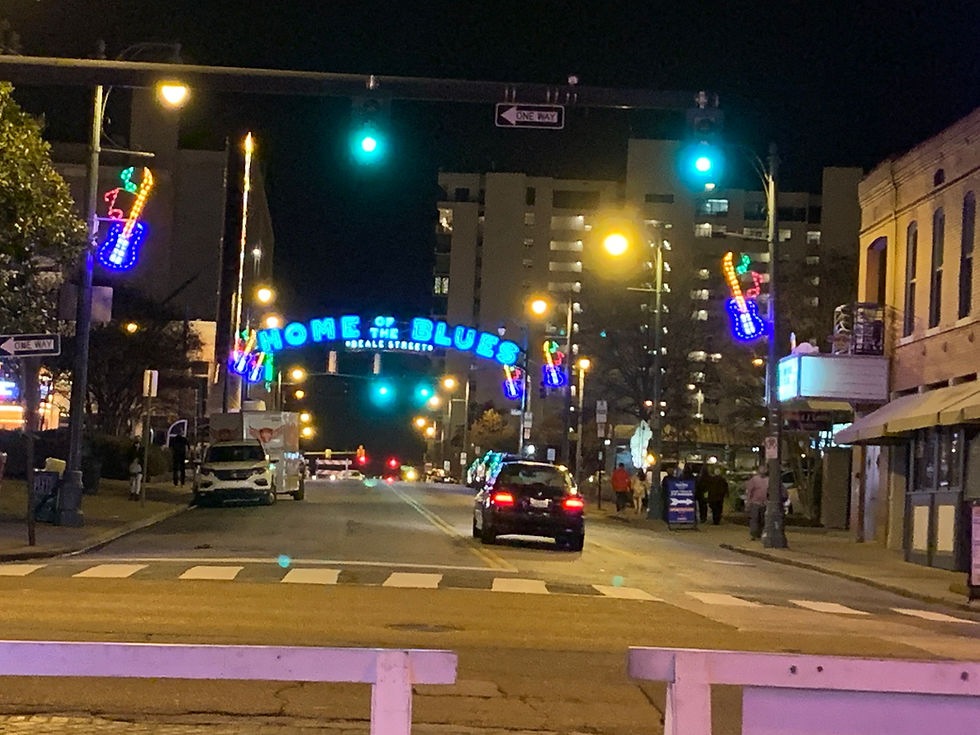
4) The Blues City Cafe in Memphis doesn’t believe in customers going away hungry. When I inquired about possible menu misprints, the waitress said, “We don’t have (ounce) steaks.” I thought better of ordering their largest sirloin. Then, the waitress mentioned something about a family meal. Indeed!


Beale and Main Streets near

the Blues City Cafe in Memphis.

5) Janet and I "toured" the World's First Billy Bass Adoption Center at the Flying Fish Restaurant in Memphis.

The main Billy Bass display wall

in the Flying Fish Restaurant.


Wouldn't cha' know?

Another Elvis Impersonator!


6) Janet had to visit Elvis' Graceland. She just had to, no ifs, ands, or buts.


Elvis' Graceland home is much

like many pre-Civil War plantation

homes across the deep south,

after a fashion.


7) Elvis' taste in home decorating, 1970s era, was nothing to envy.


Elvis' 1970s Media Room

(pre-internet social media).


8) Elvis owned and traveled via two planes.


The Lisa Marie, largest

of Elvis' two jets.


9) Elvis owned horses, and purchased numerous cars and motorcycles during his short career. I can't comment about the color of his horses, as I saw none, but his choice of Cadillac color suggests he believed if you got it, flaunt it.


Elvis' Pink Cadillac.


10) The Delta, aka Yazoo-Mississippi Delta, of some 70,000 sq miles of alluvial floodplain in Arkansas, Louisiana, and primarily Mississippi, should not be confused with the Mississippi River Delta, which terminates some miles beyond New Orleans.

11) The Delta suffered major flooding in 1927, the most destructive in US history, when the levee first failed near Mounds Landing, some 17 miles from Greenville, Mississippi. Some areas were covered by as much as thirty feet of water and at least two months elapsed before the floodwater completely subsided.


The Mississippi Delta, not to

be confused with the Mississippi

River Delta southeast of NOLA.


12) Greenville, Mississippi, boasts of “more published writers per capita” than any other town in the US, such notables include Shelby Foote.


13) Many consider The Delta as the birthplace of Blues music, and highly influential in the development of Rock and Roll, if not its birthplace as well.


14) The Mississippi River temporarily ran backwards after a series of New Madrid fault earthquakes between December 16, 1811 and February 7, 1812. Additionally, those tremors created 18-mile-long Reelfoot Lake in TN.


Reelfoot Lake near Tiptonville,

TN. (Note: Photo taken during

a separate trip.)


15) The NMSZ, New Madrid Seismic Zone, is not benign nor dormant. Ruptures have occurred numerous times and have been felt and recorded in personal journals as far away as Louisville, Kentucky and Cincinnati, Ohio.


16) Though many consider cotton the primary crop of the pre-Civil War South, corn and sugarcane figured prominently. Corn fed farm animals and sugarcane helped fuel the opulent plantation culture built upon slave labor. Touring a few notable houses on our trip, I was reminded of European royal palaces.


Nottoway Plantation Mansion.

(Note: Gentlemen, please

ascend on the right as to not

glimpse bare feminine ankle.)

17) Gators love marshmallows. Wait . . . why are they called “marsh” mallows?


Several swamp gators compete

for a marshmallow. (Note: the

brown & green is vegetation reflecting

off the water, not muck in the water.


18) Cafe Du Monde’s beignets, French doughnuts, aka fritters, are popular in the French Quarter of NOLA. Janet and I opted to stand in the take-away line for almost an hour to purchase an order, as the sit-down line appeared longer. I’m sure both lines had formed hours before our arrival, with customers placing and consuming their orders all the while. And when Janet and I left, the lines had grown longer still.


Queue for Cafe Du Monde

beignets when Janet and I

arrived on the scene.


19) Janet and I found the World War Two Museum in NOLA interesting, as we spent nearly a whole day there. I liked the museum's display of US WWII planes.


An Avenger. (Surely, not

dropping a live bomb.

(Probably not. Well, maybe

not. I hoped not, anyway.)


20) I'd expect to be hanged and quartered, if I didn’t mention Southern and Cajun cuisine, other than that above. Both Janet and I enjoy Cajun food, though only lightly spiced. However, Janet shies away from deep-fried breaded items, particularly catfish. Her catfish aversion has something to do with owning a pet catfish years ago, but that didn't deter me, at least on one occasion.


Prepared to chow down on fried

alligator, crab cake and raw oysters,

Connard photo bombs Janet's foodie

picture at the Coterie Restaurant &

Oyster Bar, NOLA.(Note: Gator tastes

like a cross between chicken

and ground beef to me.)


We thoroughly enjoyed our river cruise, felt quite satisfied and returned home fulfilled. (I'd recommend it.)


Walk in beauty.


You can email me:

connard@connardhogan.com

Subscribe to My Quarterly Newsletter

Thanks for subscribing!

Top of page

Background Photo Credit: Nick Kwan/Pexels

© 2023 by Connard Hogan. Proudly created with Wix.com

bottom of page